Your Best Science Fair Entry Might Already Be Growing on Your Windowsill
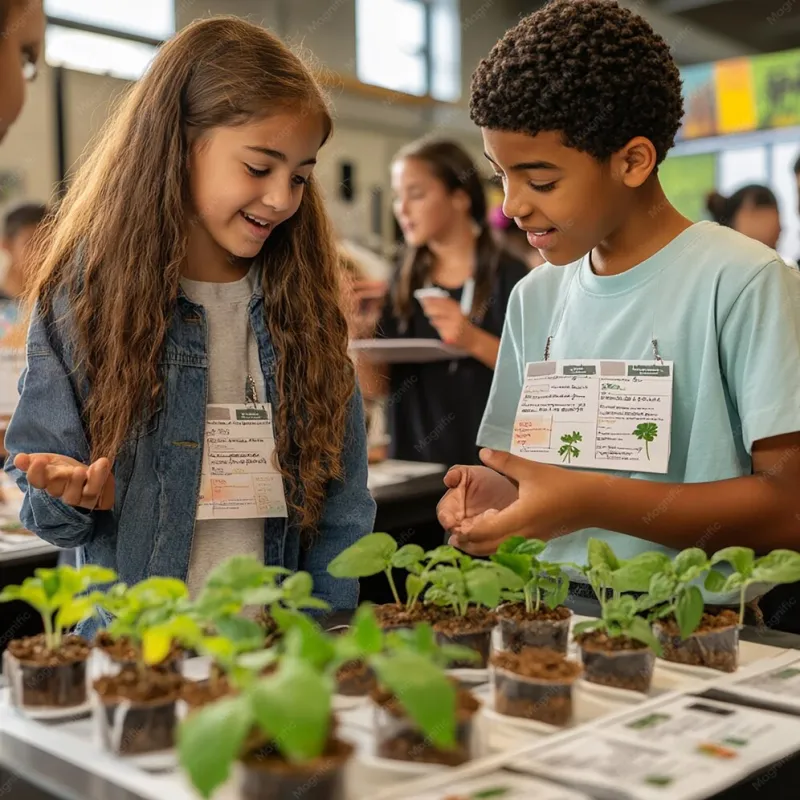
Photo: student presenting plant science fair project with data charts and seedlings, via img.freepik.com
Every February, science fair season descends on schools across the country like a mild panic. Parents are googling project ideas at midnight. Students are staring at blank display boards. Teachers are fielding questions about whether a project on "which brand of chips is crunchiest" counts as a valid experiment.
Meanwhile, right there on the classroom windowsill, a dozen perfectly good research projects are just sitting in their pots, waiting to be noticed.
Classroom plants are one of the most underutilized science fair resources in American education. They're accessible, affordable, ethically uncomplicated, and—here's the kicker—they produce data. Real, measurable, chartable data. The kind that science fair judges actually get excited about. More importantly, the kind that teaches students what scientific thinking actually feels like.
Why Plants Make Exceptional Research Subjects
Before we get into specific project ideas, it's worth understanding why plants are so well-suited to student research. Unlike animal subjects (which raise ethical concerns and logistical headaches), plants can be manipulated, monitored, and yes, occasionally sacrificed for science without any of the complications. They're slow enough that students can observe change over days and weeks rather than milliseconds, which means the process of data collection is visible and comprehensible.
Plants also respond to an enormous range of variables—light, water, soil composition, temperature, sound, touch, competition from other plants, and more. That breadth means students at every grade level can find a question that genuinely interests them. A third grader can track how tall a bean plant grows under different colored lights. A high schooler can design a controlled experiment testing whether mycorrhizal soil additives improve seedling survival rates. The plant doesn't care about grade level. It just grows.
Starting with Observation, Not a Hypothesis
One of the most common mistakes in student science fair projects is jumping straight to a hypothesis without spending time just watching. Teachers who successfully guide students toward strong botanical research projects almost always start the same way: they slow things down.
Spend two or three weeks at the beginning of the year having students simply observe classroom plants without any formal assignment attached. Who waters them? When do leaves droop? Which plants grow fastest? Which ones seem to do better near the window? Encourage students to write questions in a journal—not hypotheses yet, just questions. "Why does this one always look sad on Mondays?" is not a bad starting point. (Spoiler: it's probably the weekend watering gap.)
From those questions, genuine hypotheses emerge organically. And hypotheses born from real curiosity produce research that's far more compelling than projects assembled from a list of suggested topics.
Projects That Judges Actually Remember
Let's talk specifics, because abstract encouragement only goes so far.
Growth rate and light spectrum experiments are perennially strong projects because they're easy to control and produce quantitative data. Students grow identical seedlings—radishes and bean sprouts work well because they're fast—under different light conditions: natural light, full-spectrum grow lights, red-spectrum lights, blue-spectrum lights, or combinations. They measure height, leaf count, and stem diameter at regular intervals. The data visualization possibilities alone make for a compelling display board.
Fertilizer variable testing is another crowd-pleaser. Students divide a set of identical plants into groups and apply different fertilizer treatments: commercial liquid fertilizer, compost tea, diluted coffee grounds, plain water as a control. Over four to six weeks, they track growth metrics. This project naturally opens conversations about organic versus synthetic inputs, which connects to broader environmental literacy goals.
Soil composition studies work especially well at the middle school level. Students create custom soil mixes—varying ratios of potting mix, perlite, sand, and compost—and plant identical seeds in each. The question of which mix produces the healthiest plants introduces concepts like drainage, aeration, nutrient availability, and pH. It's a rich topic that rewards deeper research.
Pollinator documentation projects are gaining traction as environmental awareness grows. If your school has an outdoor garden space, students can systematically document which pollinators visit which plants, at what times of day, and during which weather conditions. This kind of observational research builds skills in data collection and species identification while connecting directly to the real-world crisis of pollinator decline. Projects that tie to current environmental issues tend to resonate strongly with judges.
Water stress and drought resilience experiments are particularly timely given conversations about water conservation across the US. Students subject different plant species—or the same species under different conditions—to controlled water restriction and document physiological responses: wilting patterns, leaf curl, color changes, recovery rates after rehydration. This project builds empathy for plants as living systems under stress, which is a more profound outcome than most people expect from a science fair.
Turning Care Routines into Data Collection
Here's a practical insight that experienced teachers swear by: the best student research projects don't always require starting from scratch. Sometimes they grow directly out of existing classroom care routines.
If your class already tracks watering schedules, that's a dataset. If students have been measuring plant height on a whiteboard for weeks, that's longitudinal data. If someone noticed that the plant near the heating vent always looks worse than the one by the door, that's an observation worth investigating.
Encourage students to look at what they're already doing and ask: Is there a pattern here? Is there a question hiding in this data? That shift in perspective—from caretaker to researcher—is one of the most valuable things botanical science education can offer.
What Makes a Project "Matter" Beyond the Ribbon
Science fair ribbons are nice. But the deeper goal of student-led plant research is something more durable: the experience of asking a real question, designing a way to answer it, and sitting with uncertainty while the data comes in.
Plants are patient teachers. They don't give you your results overnight. They make you check on them, adjust your methods, and reconsider your assumptions. That's not a flaw in the research experience—it's the whole point.
When a student spends six weeks tending to a set of experimental plants, recording measurements, troubleshooting unexpected outcomes, and finally presenting what they found to a panel of judges, something shifts. They're not just doing a school project anymore. They're doing science.
And it all started with a seed on a windowsill.