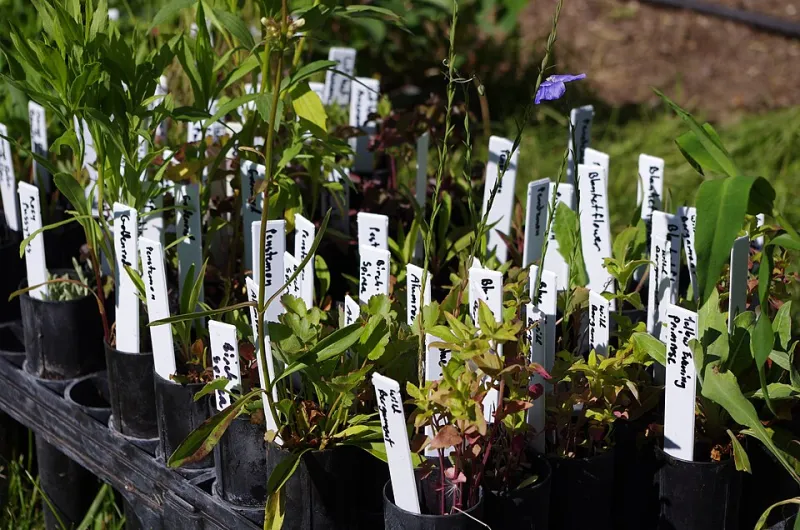
Leaves, Lungs, and Learning: How Classroom Plants Are Quietly Advancing School Climate Goals
Photo: Joshua Tree National Park, Public domain, via Wikimedia Commons
When a school district announces a new climate action plan, the conversation usually gravitates toward solar panels, electric buses, and LEED-certified buildings. Those are important investments, no question. But there's a lower-cost, higher-engagement strategy that rarely makes it into the sustainability report — and it's been sitting on classroom windowsills all along.
Classroom plants aren't just decorative. They're doing real environmental work. And when schools start tracking that work, the numbers are compelling enough to get administrators, school boards, and even grant committees paying attention.
What Plants Actually Do for Indoor Air
Let's start with the science, because it's more interesting than most people expect. Plants absorb carbon dioxide and release oxygen through photosynthesis — that part most of us remember from middle school. But the indoor air quality story goes deeper.
Research from NASA's Clean Air Study (still widely cited in environmental education circles) found that certain houseplants can reduce concentrations of volatile organic compounds (VOCs) like benzene, formaldehyde, and trichloroethylene. These aren't exotic chemicals — they off-gas from common classroom materials like carpet adhesives, whiteboard markers, and cleaning products.
More recent work from researchers at Drexel University and the University of Georgia has added nuance to this picture. The effect isn't enormous in a single plant, but it scales. A classroom with 10–15 plants distributed near air circulation points shows measurably lower CO₂ concentrations than a comparable room without them, particularly in the mid-afternoon slump when CO₂ buildup from student respiration peaks.
Why does that matter for learning? Because elevated indoor CO₂ — even at levels well below safety thresholds — is consistently linked to reduced cognitive performance. Studies published in Environmental Health Perspectives found that decision-making scores dropped significantly when CO₂ levels climbed past 1,000 parts per million, a threshold that's routinely exceeded in crowded, poorly ventilated classrooms. Plants help buffer that buildup.
Putting Numbers to the Green
Here's where teachers can get really practical. If you want to make a case to your principal or curriculum director, you need data — not just vibes.
A single medium-sized potted plant (think a peace lily, pothos, or snake plant) absorbs roughly 100–200 grams of CO₂ per year under typical indoor light conditions. That's modest on its own. But scale it across a classroom of 20 plants, multiply that across 30 classrooms in a school, and you're looking at 60,000–120,000 grams — 60 to 120 kilograms — of CO₂ absorbed annually within the building itself.
For context, the average American car emits about 4,600 kilograms of CO₂ per year. So no, classroom plants aren't going to offset a school's entire carbon footprint. But that's not the right frame. The right frame is this: classroom plants are a zero-cost (or near-zero-cost), student-powered contribution to a school's sustainability metrics that also improves learning conditions. That's a story worth telling.
Several schools are already telling it well.
Schools Leading the Way
At Brookside Elementary in Ann Arbor, Michigan, a fifth-grade teacher named Ms. Okafor started a classroom plant tracking project three years ago as part of a broader district sustainability initiative. Students log plant growth, estimate biomass accumulation, and calculate approximate carbon sequestration using age-appropriate formulas. The data gets submitted to the school's annual sustainability report.
"The kids take it incredibly seriously," she told a regional environmental education conference last year. "When they know their work is going into a real report that goes to the school board, the engagement is completely different."
In Portland, Oregon, Jefferson High School's environmental science classes maintain a 200-plant indoor garden distributed across multiple classrooms and common areas. The school uses this as part of its application for Oregon's Green School certification — a program that rewards measurable sustainability practices with recognition and funding opportunities.
And in Houston, Texas, where school buildings often run air conditioning for nine or more months a year, a cluster of middle schools in the Spring Branch Independent School District has begun tracking indoor air quality metrics before and after introducing classroom plant programs. Early results, shared at a district wellness committee meeting, showed a 12% reduction in mid-afternoon CO₂ spikes in rooms with established plant collections.
Turning Your Classroom Into a Data Station
You don't need a grant or a science lab to start generating meaningful data. Here's a simple framework any teacher can implement:
Step 1: Baseline your air. Affordable CO₂ monitors (around $50–$80 on Amazon or through educational supply vendors) can give you a real-time picture of your classroom's air quality at different points in the day. Take readings before and after introducing plants.
Step 2: Document your plant collection. Record species, pot sizes, and placement. This lets you correlate specific plants with air quality changes over time.
Step 3: Connect to school sustainability goals. Most US school districts with climate commitments have a sustainability coordinator or a relevant committee. Request five minutes at a meeting and bring your data. You'll often find more interest than you expected.
Step 4: Let students own the reporting. When kids are the ones presenting findings to adults, the educational impact multiplies. It builds science communication skills, civic agency, and a genuine sense of contribution.
Plants as Climate Action, Not Just Decoration
There's a tendency in environmental education to treat big climate solutions as things that happen somewhere else — in policy rooms, in corporate boardrooms, in international negotiations. That framing leaves students feeling like spectators.
Classroom plants flip the script. They're a climate intervention that students can touch, tend, measure, and report on. They connect daily care routines to larger environmental systems. And they produce data that can actually influence school decisions.
That's not a small thing. In a moment when climate anxiety is rising among young people — surveys from the American Psychological Association consistently find that a majority of teenagers report significant stress about climate change — giving students a concrete, productive action they can take in their own learning environment is genuinely valuable.
The potted snake plant in the corner of your classroom isn't going to save the planet by itself. But it's doing real work, and it's teaching real lessons. When we help students see that, we're not just growing plants. We're growing the next generation of environmental thinkers — one leaf at a time.