The Neighborhood Is the Field Trip: Finding Native Plants Right Outside Your School's Front Door

Photo by Photo by Regi Munandar on Unsplash on Unsplash
Here's a thought experiment: What if the best botanical field trip your students ever take costs nothing, requires no permission slip for transportation, and starts the moment they step off school property?
For teachers in cities and dense suburbs across the country, that's not a hypothetical. It's a reality that's been hiding in plain sight — literally under their students' feet. Native plants are tougher, more adaptable, and more widespread than most people give them credit for. And once you train your eyes (and your students' eyes) to spot them, the urban landscape transforms from concrete monotony into something that looks a whole lot like a living ecosystem.
This isn't just a nice idea. It's a genuinely powerful way to connect kids — especially kids who've grown up without much access to traditional "nature" — to the botanical world around them.
Why Urban Native Plants Are Actually Kind of Incredible
Let's be honest: most people walk past native plants every single day without recognizing them. That low-growing cluster of leaves pushing through a sidewalk crack near the school bus stop? Possibly common plantain (Plantago major), a plant with a history of medicinal use stretching back centuries and a resilience that would make any botanist tip their hat. The tall, slightly scraggly plants taking over the chain-link fence at the edge of the parking lot? Could be goldenrod, pokeweed, or even a young sumac — all native, all ecologically important, all completely overlooked by the average commuter.
Urban environments actually support a surprising diversity of native flora. Street medians, vacant lots, highway edges, community garden borders, and even rooftop containers can harbor plants that evolved specifically for regional conditions. These aren't invasive species muscling their way in — many are exactly where they belong, doing exactly what they've always done, just with a lot more concrete nearby.
For students who've been told their whole lives that "nature" is somewhere else — out in the country, tucked inside a national park — discovering that it's also right here can be genuinely revelatory.
Turning a Walk Around the Block into a Botanical Expedition
The trick is framing. A walk is just a walk. A botanical expedition is a mission.
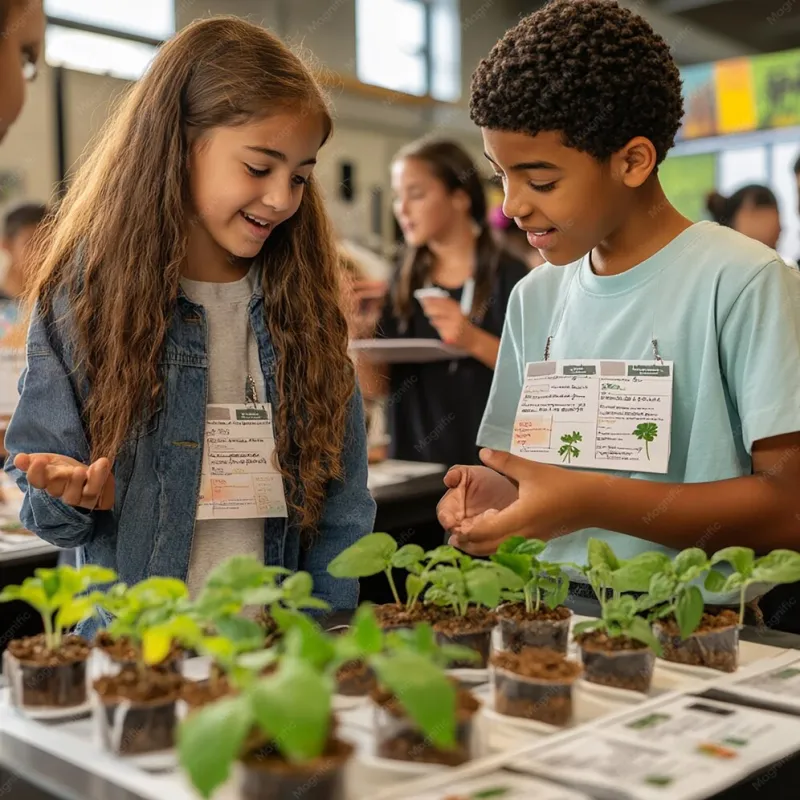
Before heading outside, arm your students with a simple field observation sheet. Keep it low-pressure: a column for sketching the plant, a column for noting where it was found (sidewalk crack, garden edge, planter box, etc.), and a column for a few descriptive words — leaf shape, color, texture, height. You're not asking them to identify anything yet. You're asking them to see.
Apps like iNaturalist and PlantNet have become genuinely useful classroom tools here. Students can photograph a plant on a school-issued device or tablet, and within seconds get a probable identification backed by a community of scientists and enthusiastic naturalists. That moment when the app confirms that yes, that weedy-looking thing by the fire hydrant is actually a native violet? It tends to land differently than reading about violets in a textbook.
For the walk itself, a few practical tips:
- Scope your route in advance. Do a quick solo walk to identify two or three reliable plant spots. Urban flora can be unpredictable, and you don't want to promise students a discovery and come up empty.
- Go slow and go small. A two-block radius explored carefully beats a six-block sprint. Native plants often occupy tiny niches — a single crack, one corner of a planter — and rushing past means missing them entirely.
- Bring a local field guide or print native plant ID cards. Organizations like the Lady Bird Johnson Wildflower Center and many state native plant societies offer free regional resources. A laminated card with ten common urban native plants in your region is worth its weight in gold.
- Let students lead the spotting. Resist the urge to point everything out yourself. The discovery hits harder when it's theirs.
Bringing It Back to the Classroom
The expedition doesn't end when you walk back through the school door. That's where things get interesting.
If local regulations and landowner permissions allow — and it's worth checking — students can collect small cuttings or seeds from certain plants to propagate back in the classroom. A sprig of native mint from a community garden, a few seeds from a black-eyed Susan growing along a fence line: these become living connections between the neighborhood and the learning environment. Suddenly, that plant on the windowsill isn't just a plant. It's a plant from somewhere specific, with a story your students personally witnessed.
For classes where collecting isn't feasible, photographs work beautifully as the foundation for deeper research projects. Students can build individual "plant profiles" — a kind of field guide entry — for the species they documented. What are this plant's ecological relationships? What insects or birds depend on it? Is it used in any traditional or Indigenous contexts? What does its presence tell us about the health of the urban environment where it was found?
That last question opens up genuinely rich territory. Native plants are often indicators of soil and air quality, water drainage patterns, and the overall ecological condition of a neighborhood. A block with a diverse population of native volunteers is telling you something different than a block where nothing grows except a few aggressive invasives. Teaching students to read those signals is a form of environmental literacy that extends well beyond botany.
Making It a Recurring Practice, Not a One-Time Event
One neighborhood walk is a good lesson. A series of neighborhood walks across different seasons is a curriculum.
Urban native plants shift dramatically throughout the year. The goldenrod that's blooming in September is dormant by December. The early spring ephemerals — tiny wildflowers that emerge briefly before the tree canopy fills in — are gone by June. Building in even two or three outdoor observation walks per year gives students a sense of plant life cycles that no diagram in a textbook can fully replicate.
Some teachers have formalized this into a "neighborhood plant journal" that students maintain across a full school year, adding new observations and returning to previous sites to document change. It's low-cost, academically rigorous, and the kind of project that students actually remember long after the school year ends.
The Bigger Picture
There's something quietly powerful about telling urban kids that the environment isn't just a far-off abstraction — that it lives in their neighborhood, on their block, maybe even in the crack right outside their apartment building. Native plants in cities are survivors. They're resilient, adaptive, and deeply connected to the ecological history of a place, even when that place has been dramatically transformed by human development.
Helping students see and name those plants is, in a small but meaningful way, helping them see themselves as part of an ecosystem rather than separate from it. And that shift in perspective? That's exactly the kind of thing a plant in every classroom — and every neighborhood — can quietly, persistently grow.