Not All Green Is Created Equal: The Science Behind Which Classroom Plants Actually Do Something

Let's be honest: most of us got into classroom plants because they feel good. A spider plant in the corner, a snake plant on the shelf, maybe a little succulent collection on the windowsill — it makes the room feel warmer, more alive, more like a place where things grow. And that instinct isn't wrong. But there's a version of classroom plant culture that's quietly running on vibes instead of science, and if you're telling your students that a single pothos is cleaning the air they breathe, you might be doing them — and the plant — a disservice.
This isn't a takedown of classroom greenery. Far from it. It's an invitation to go deeper, to match the enthusiasm with the evidence, and to make plant choices that actually move the needle on the things you care about.
The NASA Study Everyone Keeps Misquoting
If you've spent any time in plant-loving teacher circles, you've probably heard about the NASA Clean Air Study. Published in 1989, it became the foundational document for the idea that houseplants remove toxins from indoor air. Peace lilies! Golden pothos! Spider plants! The study identified several species that absorbed volatile organic compounds (VOCs) like benzene and formaldehyde in a sealed chamber environment.
Here's the problem: your classroom is not a sealed chamber.
A 2019 meta-analysis published in the Journal of Exposure Science & Environmental Epidemiology looked at 196 plant studies and found that you'd need somewhere between 10 and 1,000 plants per square meter to match the air-cleaning effect of simply cracking a window. In a real classroom with real ventilation — even bad ventilation — the air exchange rate far outpaces what a handful of plants can do.
That doesn't mean plants have zero effect on air quality. It means the effect is modest, and it's worth being precise about what you're claiming when you talk to students about it.
What Plants Actually Do Well (And It's Still Pretty Great)
So if the air purification story is overstated, why bother? Because the real benefits of classroom plants are well-documented, and honestly, they're more interesting.
Humidity regulation is one of the more underappreciated wins. Plants release water vapor through transpiration, and in dry classroom environments — especially during winter when heating systems pull moisture out of the air — even a modest cluster of plants can measurably increase relative humidity. Dry air is linked to increased respiratory irritation and higher rates of cold transmission. A few well-chosen plants near student work areas can make a genuine difference here. Species like peace lilies, Boston ferns, and arrowhead plants are particularly effective transpirators.
Psychological and cognitive effects are where the research gets genuinely exciting. Multiple studies — including work out of the University of Exeter and Norwegian research from the 1990s that's been replicated since — have found that the presence of plants in work and learning environments is associated with reduced stress, improved attention span, and higher reported wellbeing. These aren't enormous effect sizes, but they're consistent. And in a classroom where attention is already a scarce resource, consistent matters.
Noise reduction is a benefit almost nobody talks about. Plants — especially larger, leafy varieties with dense foliage — absorb and diffract sound. In a hard-walled classroom with tile floors, that's not nothing. A few strategically placed larger plants can soften the acoustic environment in a way that benefits both students and teachers.
The Species Question: Making Smarter Choices
Once you've recalibrated what you're optimizing for, the species question gets a lot more interesting. Instead of asking "which plant cleans the air best," you're asking things like: Which plants transpire most efficiently? Which ones are most psychologically engaging for students? Which ones will thrive under fluorescent lights with intermittent watering from a 10-year-old?
For humidity and transpiration, Boston ferns and peace lilies are genuine workhorses, though they need more consistent moisture than most classroom situations naturally provide. Pothos and philodendrons are lower-maintenance options that still contribute meaningfully to humidity levels.
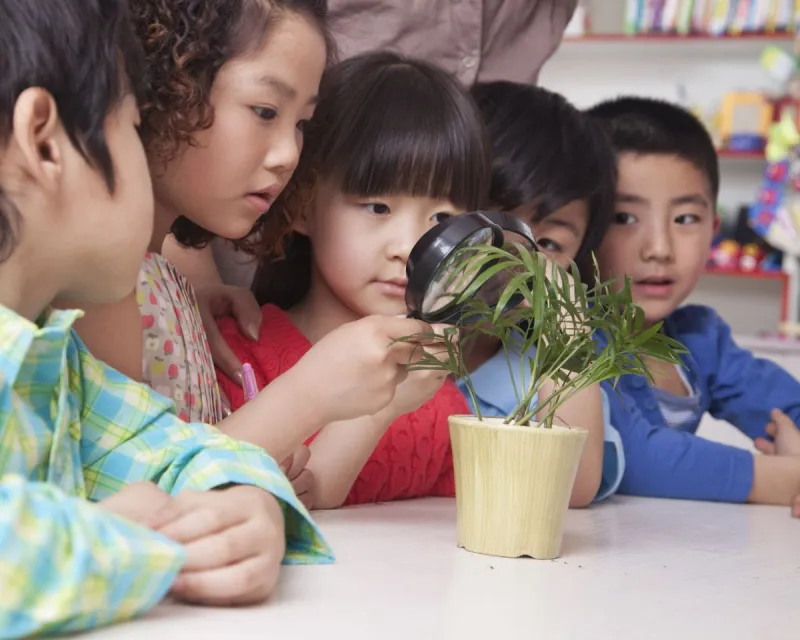
For psychological engagement and visual interest — which drives the attention and wellbeing benefits — you want variety, texture, and ideally some element of observable change. Fast-growing vines that students can watch spread across a trellis, herb gardens that engage smell as well as sight, and flowering plants that mark the passage of time with blooms are all high-impact choices for student engagement.
For noise softening, larger specimen plants — think a well-established fiddle leaf fig, a big monstera, or a mature rubber plant — do more work than a collection of small succulents. Placement matters too: plants positioned between noise sources and student seating areas are more effective than plants clustered in a corner.
Turning the Misconception Into the Lesson
Here's the thing that makes this whole conversation genuinely exciting from an educational standpoint: the gap between popular belief and scientific evidence is itself a fantastic teaching tool.
The NASA study story — what it actually found, what it didn't find, how it got simplified and amplified into something it never claimed to be — is a perfect case study in science communication and media literacy. Walk your students through it. Show them the original study. Show them the 2019 meta-analysis. Ask them why the simplified story spread so much faster than the nuanced one.
Then ask them what questions they would design a study to answer. How would you actually measure whether your classroom plants are affecting the air? What would you need to control for? What would count as meaningful evidence?
Suddenly your pothos isn't just a plant. It's a lesson in how science works, how information spreads, and how critical thinking applies to things we already believe.
Good Intentions Are the Starting Point, Not the Finish Line
None of this is meant to make you feel bad about the spider plant that's been living on your filing cabinet for three years. Good intentions got it there, and good intentions matter. Plants in classrooms are a net positive — for student mood, for classroom culture, for the quiet daily message that living things deserve care and attention.
But good intentions are more powerful when they're paired with good information. When you know why you're choosing a Boston fern over a cactus, when you can explain to your students what transpiration actually does to the air around them, when you can use the gap between myth and evidence as a teachable moment — that's when a classroom plant stops being decoration and starts being education.
And that's kind of the whole point, isn't it?