Succulents Are Great. But Are They Quietly Letting Your Students Off the Hook?
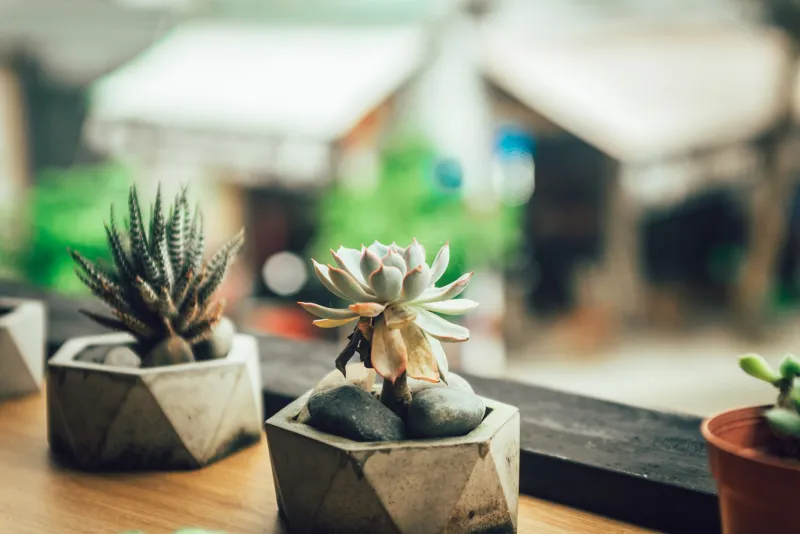
Walk into almost any American classroom with a plant on the windowsill, and there's a pretty good chance it's a succulent. A squat little echeveria. A rubbery jade plant. Maybe a cactus someone's grandmother donated after it outgrew her kitchen counter. They're everywhere — and honestly, it's not hard to see why.
They're cheap. They're cute. They survive neglect that would send a peace lily into full dramatic collapse. For a teacher already juggling thirty kids, a curriculum binder, and a broken projector, a plant that basically takes care of itself sounds like a gift.
But here at A Plant In Every Classroom, we've been sitting with an uncomfortable question lately: What exactly are these nearly indestructible plants teaching our students about the natural world?
The answer might not be what we'd hope.
The Seduction of the 'Unkillable' Plant
The marketing around succulents is relentless. Garden centers, big-box stores, even school supply catalogs pitch them as the perfect starter plant — resilient, forgiving, ideal for beginners. And in a purely horticultural sense, that's not wrong. Succulents evolved in some of the harshest environments on Earth, storing water in their thick leaves and stems to survive long dry spells. They are, genuinely, built for neglect.
But here's the thing about classrooms: they're not just places to keep plants alive. They're places to learn. And when the primary lesson a plant communicates is you don't really have to do much, we might be accidentally undermining some of the most important ecological ideas we're trying to build.
Succulents don't ask for much because they evolved not to need much. That's a fascinating survival story — one absolutely worth exploring in a science unit. But when a plant's defining characteristic becomes a reason to disengage from it, we've turned a biology lesson into a hall pass.
What Active Plant Care Actually Teaches
Think about what happens when a classroom tends a plant that genuinely requires attention. Students learn to observe — really observe. They notice when leaves start to yellow, when soil feels bone-dry two days after watering, when a stem tilts toward the window. They start asking why. They develop what environmental educators call ecological attentiveness — a habit of noticing the living world and recognizing that it responds to what we do (or don't do).
More than that, they start to internalize something profound: ecosystems require participation. A thriving garden, a healthy watershed, a forest that regenerates — none of these things happen on autopilot. They depend on relationships, on inputs, on the ongoing labor of organisms (including humans) doing their part.
When the classroom plant is something that genuinely needs you — a fern that wilts without humidity, a basil plant that bolts if you don't pinch it back, a tomato seedling racing toward the light — students experience that interdependence firsthand. They become part of the system. The plant's wellbeing is, in a small but real way, connected to their choices.
A succulent that shrugs off a month of zero attention doesn't offer that same feedback loop.
The Resilience Myth Worth Unpacking
Here's where things get genuinely interesting from an educational standpoint — and where succulents can actually become a better teaching tool, if we're willing to reframe the conversation.
We talk a lot about resilience in schools. It's a buzzword in social-emotional learning, in climate education, in science standards. But resilience in ecology doesn't mean not needing anything. It means the capacity to recover and adapt — which still requires inputs, relationships, and favorable conditions over time.
A succulent's drought tolerance isn't a model of self-sufficiency. It's a highly specialized adaptation to a specific environment. Drop that same cactus into a Pacific Northwest rainforest and it'll rot within a season. Its resilience is contextual, conditional, deeply tied to place.
That's a rich lesson. But it only gets taught if someone's asking the question.
If students interact with a succulent purely as "the plant that doesn't die," they miss the nuance entirely. They walk away with a vague impression that tough things don't need care — which is, frankly, one of the more dangerous misconceptions we can cultivate in the next generation of environmental stewards.
So Should You Ditch Your Succulents?
Not necessarily. This isn't a succulent takedown. It's a call to be intentional about what any classroom plant is actually teaching.
If you have succulents in your room, lean into their story. Talk about where they come from — the Sonoran Desert, the mountains of South Africa, the volcanic soils of the Canary Islands. Explore why they store water, and what that tells us about adaptation and survival under pressure. Compare them with plants from wetter climates and ask students what would happen if you swapped their environments. Use the contrast to illuminate how specialized and place-dependent resilience really is.
But also consider adding a plant that asks something of your students. An herb garden on the windowsill. A native wildflower started from seed. A bean plant threading its way up a bamboo stake. Something that will visibly struggle without consistent care, and visibly thrive when it gets it.
That visible feedback — the drooping leaf that perks back up after watering, the new growth that appears after a week of careful tending — is the kind of embodied learning that sticks. It's the kind that builds the intuition kids need to understand why wetlands matter, why pollinators need habitat, why a monoculture corn field is ecologically fragile even when it looks lush and productive.
The Bigger Picture
At its core, environmental education is about relationships. It's about helping young people understand that they are not separate from the natural world — that their choices ripple outward into living systems that respond, adapt, and sometimes collapse under pressure.
A plant that never asks anything of a student can't teach that. A plant that does — one that communicates its needs clearly, rewards attention, and declines without care — makes that relationship visible in a way no textbook diagram can match.
Every plant in every classroom has the potential to be a teacher. The question worth asking isn't just will this plant survive? It's what will this plant teach?
Sometimes the answer to that question is worth more than the convenience of a plant that never dies.